
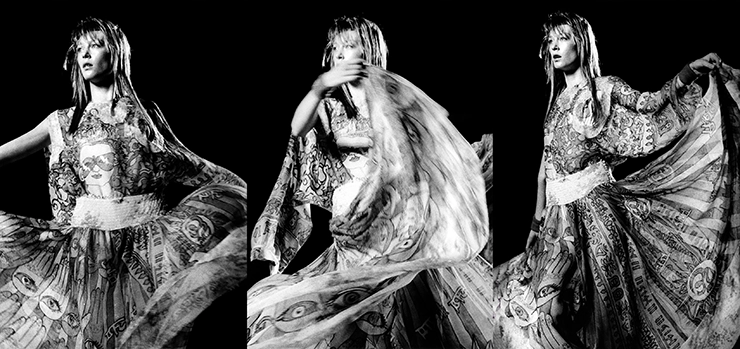
Our interview with the French photographer Julien Spiewak who began his career photographing fashion shows for Dior, Chanel, Yves Saint Laurent and Versace, and now creating artistic photographs that connect the human body to works of fashion and art in private collections and museums worldwide.
The Fashiongton Post: Julien, you started by photographing fashion in motion. When did stillness become more powerful to you than movement?
Julien Spiewak: I began more than twenty years ago photographing fashion shows in Paris, notably for Dior, Chanel, and Saint Laurent. I deeply loved that period—the energy, the rhythm, the intensity of movement. But quite quickly, I felt the need to create images rooted in my own universe, where I could place the human body in dialogue with works of art, furniture, and architecture. To do that, I no longer needed to capture a fleeting moment, but rather to position the body in a precise, almost self-evident way within the frame. Moving from motion to stillness was a radical shift in my working method, but it opened up an immense sense of creative freedom.
F.P.: If Dior, Chanel, and Saint Laurent were museums instead of fashion houses, what kind of art would hang on their walls?
J.S.: That’s a wonderful question. Fashion houses increasingly reference art history and collaborate with contemporary artists. I imagine the walls of Dior, under Jonathan Anderson, filled with 18th-century animal paintings—particularly hedgehogs and pigeons—in reference to the motifs he recently explored through accessories. For Yves Saint Laurent, I envision a very colorful collection, similar to the one the designer himself owned: works by Matisse, Picasso, and Mondrian, where color, line, and composition resonate strongly with fashion.
F.P.: What did fashion shows teach you about the human body that museums never could—and vice versa?
J.S.: In certain fashion shows, bodies become almost sculptural. I vividly remember my first Jean-Paul Gaultier show in 1998: marble busts occupied the runway, and the models wore hairstyles covered in plaster. Without realizing it at the time, that show foreshadowed my current photographic series, Corps de style. Today, I literally dress bodies with marble, sculptures, and furniture. The major difference is that in fashion shows, bodies are in constant motion, whereas in museums I must find a single, perfect position where the body and the artwork become one.
F.P.: Was there a specific photograph that made you realize you were no longer documenting fashion, but creating art?
J.S.: My earliest experiments for Corps de style featured dressed models paired with furniture, but the images still felt very fashion-driven. The true turning point came when I removed the clothing: suddenly, they were no longer models, but bodies, placed in relation to artworks. That was when I decided to fully explore the concept and begin developing the series. The first photographs were made in private homes belonging to collectors of antique furniture, and soon after in museums in France, Italy, Switzerland, and Monaco. Each project is a meeting with a collection, a history, and a place. Bodies merge with artworks and architecture through curves, colors, and material textures. I try to introduce an element of mystery, and sometimes humor. Each image has its own codes and references.
F.P.: Do you think the human body competes with art objects, or completes them?
J.S.: People often tell me my images are very original, but to me, furniture has always been an extension of the body’s curves. In certain periods, cabinetmakers allowed animal legs to appear on the feet of chairs or chests of drawers. Pairing contemporary bodies with antique furniture therefore felt completely natural. The photograph taken at the Prince’s Palace of Monaco, featuring the carved foot of a table de milieu, perfectly illustrates the concept of the series: the model’s hand is in perfect symmetry with the animal’s paw. Body and setting become one.
F.P.: What part of the body do you find most “architectural,” and why?
J.S.: The body as a whole is deeply architectural. In my photograph Marble Column, Carole, made at the Ariana Museum in Geneva, I paired a large portion of the body with monumental pink marble columns. The curves, colors, and material qualities merge seamlessly. The columns appear to have been sculpted like bodies, while the human body seems to echo the marble’s color and veining. Flesh and material become extensions of one another.
F.P.: Fashion photography often glorifies perfection. Has your relationship with imperfection changed since working with fine art?
J.S.: Fashion photography does tend to glorify perfect bodies and flawless skin, whereas my artistic work plays with imperfection. In Louis XV stair banister of Keizersgracht 672 (ca. 1750), Léopold, photographed at the Van Loon Museum in Amsterdam, I chose to highlight body hair and moles. The back becomes the ideal backdrop for a patinated bronze element marked by time. The dark spots on the bronze resemble “beauty marks,” traces of age and life. Similarly, in Marble, Florence, photographed recently at the Hôtel Hermitage Monte-Carlo, the veins of the arm recall those of the marble. I particularly love this image because it becomes almost abstract—it is at once a portrait, an abstract landscape, and an architectural image. The boundaries between photographic genres dissolve.
F.P.: What is the most radical thing you have not photographed yet?
J.S.: There are still many places where I would like to develop projects. I recently visited the French Ministry of Culture in Paris. The minister’s office occupies the Valois wing of the Palais Royal, a symbolic seat of the Republic and a building steeped in history, as Jérôme Bonaparte once resided there. Creating a new series in a space where power is still exercised today, while being housed within a historic setting, would represent a true artistic challenge for me.
F.P.: Some argue film slows the eye, while digital accelerates it. Which do you feel guides your vision better?
J.S.: Since I now photograph in museums, preparation is essential. I spend a great deal of time organizing each shoot: I take scouting photographs, print them in black and white in my studio, and draw over them with colored pencils to explore framing and the placement of the models. I also annotate these preparatory sketches with a list of the artworks present in the image, which helps me define the final title of the photograph. The transition to digital has not changed my practice, as my final images are already pre-visualized through these preparatory studies.
F.P.: Traditionally, your piece of advice to The Fashiongton Post readers?
J.S.: Never hesitate to immerse yourself in art history—it is a magnificent source of inspiration for contemporary creation. Fashion, photography, and all the arts constantly reference works from the past.
Official website of Julien Spiewak : www.julienspiewak.com
Julien Spiewak is represented by: Pegasus Group (New-York), Espace_L Gallery (Geneva), NM Contemporary Gallery (Monaco), Alvaro Alcazar Gallery (Madrid) and West Eden Gallery (Bangkok).
The post Julien Spiewak appeared first on The Fashiongton Post.