
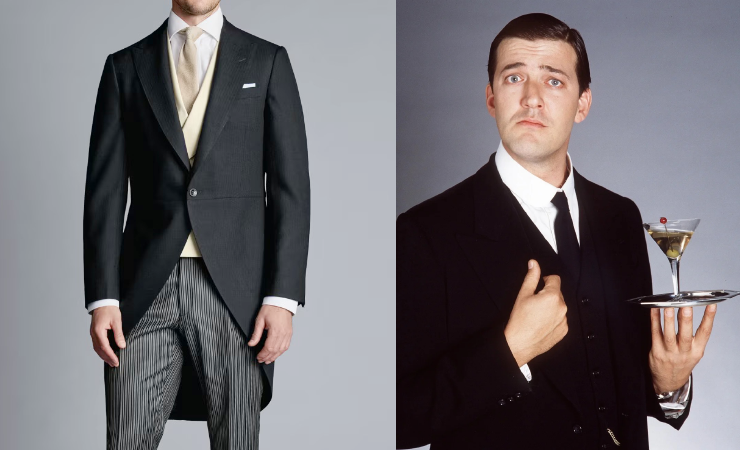
The character of Jeeves, created by P.G. Wodehouse, has become a global symbol of the quintessential English valet. Although Jeeves is technically a valet, not a butler, his influence on the image of impeccable servant attire has been enormous. Over the years, Jeeves has come to represent the peak of polished, understated style, setting a near-unattainable standard for formal menswear. His clothing choices not only reflect his personal dedication to his craft but have also shaped cultural expectations of what a perfectly dressed gentleman’s gentleman should look like.
The traditional butler or valet attire that Jeeves epitomizes is rooted in Edwardian and early 20th-century British fashion. The classic ensemble includes a black or dark gray morning coat, matching trousers, a pristine white shirt with a stiff collar, a black waistcoat, and a carefully tied tie or cravat. This look, formal yet discreet, is designed to convey seriousness, reliability, and an almost invisible presence, allowing the employer to shine while the servant remains respectfully in the background.
What makes Jeeves stand out is his meticulous attention to detail. Wodehouse describes Jeeves as always impeccably turned out, with never a wrinkle, smudge, or loose thread. This perfection is not just about vanity but about maintaining the dignity of his position and, by extension, his employer’s household. The pressed trousers, gleaming shoes, and precisely knotted ties all signal Jeeves’s commitment to excellence. His appearance reflects the highest standards of professionalism, turning the act of dressing into a form of silent service.
Another key aspect of Jeeves’s style is its timelessness. While fashion trends changed drastically through the 20th century—from the wide lapels of the 1920s to the sharp tailoring of the 1960s—Jeeves’s attire remained firmly rooted in tradition. This unchanging look reinforces the idea that true elegance transcends passing fads. Jeeves’s wardrobe choices remind us that some garments are eternally stylish because they are linked to discipline, precision, and purpose rather than fleeting trends.
Jeeves also represents an ideal of minimalism. Unlike the flashier characters in Wodehouse’s stories, such as his employer Bertie Wooster, Jeeves’s clothing never calls attention to itself. There are no loud patterns, bright colors, or experimental cuts—just the essentials, executed flawlessly. In a world increasingly saturated with bold and fast fashion, Jeeves’s understated aesthetic feels surprisingly modern and relevant today. It champions the idea that quality and fit matter more than eye-catching design.
Culturally, Jeeves has shaped perceptions of what proper servant attire should be not just in Britain but globally. Films, television adaptations, and even advertising have leaned heavily on his image to signal trustworthiness and old-world charm. The archetypal “Jeeves look” has come to symbolize a level of service and refinement that few can match. His influence is visible not just in pop culture but also in real-world uniforms for high-end service roles in hotels and private clubs.
Moreover, Jeeves’s perfection in dress extends metaphorically to his role. Just as his clothing is immaculate, so too is his conduct: calm, intelligent, and always one step ahead. This merging of form and function reinforces the idea that what we wear is a reflection of who we are. For Jeeves, being impeccably dressed is not just about appearance—it’s an outward expression of inner excellence.
In conclusion, Jeeves perfected the butler (and valet) dress code by embodying the ideals of meticulous care, timeless style, and understated elegance. His influence extends far beyond the pages of Wodehouse’s novels, shaping how we view formal service attire even today. For anyone interested in classic menswear, Jeeves remains the gold standard—a reminder that true style is as much about precision and discipline as it is about the clothes themselves.
The post How Jeeves Perfected the Butler Dress Code appeared first on The Fashiongton Post.