
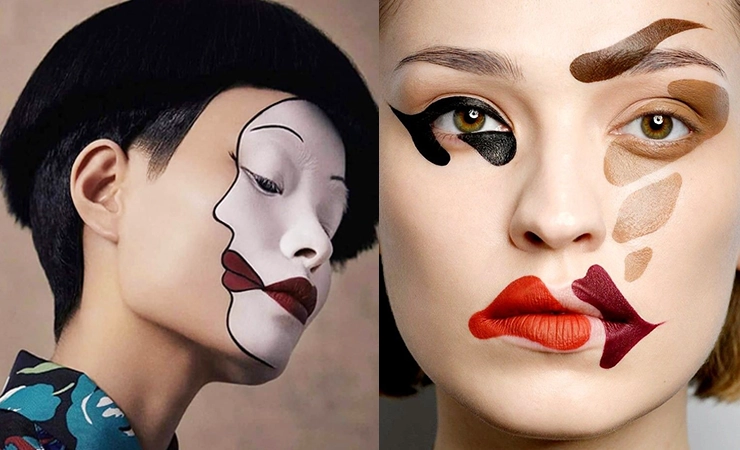
Imagine makeup that doesn’t make you more beautiful in the conventional sense of the word. Instead of enhancing your facial features, it deliberately disrupts them. A black geometric stripe cuts across the eye. Contrasting lines alter the proportions of the face. It looks like a futuristic art project, an avant-garde fashion editorial, or the appearance of a science-fiction character. But behind this aesthetic lies more than just a desire to stand out.
In an era when cameras accompany us almost everywhere and algorithms can recognize faces in fractions of a second, privacy is gradually becoming a new luxury commodity. And fashion, as always sensitive to cultural shifts, is beginning to explore this new reality.
When Invisibility Becomes Desirable
For a long time, social media dictated the rules of beauty. Perfect skin. Perfect symmetry. Perfect lighting. The world was striving to be seen. Today, the mood is changing. A generation raised under conditions of constant digital presence is increasingly asking a different question: what if not everything should be available for viewing? What if the right to remain unnoticed becomes just as valuable as the opportunity to be in the spotlight? It is no surprise that designers and makeup artists are becoming increasingly fascinated by the idea of controlling one’s own visibility. Thus emerges a new kind of beauty—not for likes and algorithms, but for the individual who wants to decide for themselves when they will be seen.
CV Dazzle: Makeup That Confuses Machines
One of the most famous examples of anti-surveillance beauty is a makeup style known as CV Dazzle. Instead of traditional contouring techniques designed to enhance the face, this approach does the opposite. Graphic lines, asymmetry, unusual color blocks, and unconventional hairstyles disrupt the familiar proportions that facial-recognition systems rely upon. The result looks surprisingly fashionable.
CV Dazzle looks often evoke references to Japanese avant-garde fashion, punk culture, and futuristic runways. Some resemble editorial shoots from the archives of early-2000s fashion magazines, while others appear as though they were created for a world fifty years in the future. This is precisely why the concept has long moved beyond the boundaries of a technological experiment. It has become part of visual culture.
A New Aesthetic of Mystery
Over the past several years, the luxury industry has increasingly turned its attention to the theme of anonymity. Oversized silhouettes, large sunglasses, hoods, veils, masks, and covered forms regularly appear on runways. These elements are hardly new, yet today they are perceived differently. Whereas such details once symbolized the glamorous mystery of movie stars, they now carry additional meaning.
They speak of control, of the ability to conceal part of oneself from the outside world, and of the right to maintain distance within a culture of constant openness.
In this context, anti-surveillance is less a technological concept and more a new interpretation of one of fashion’s oldest ideas—the idea of mystery. After all, luxury has always been associated with inaccessibility. It is impossible to desire something that is completely revealed.
Why Privacy Is Becoming a New Status Symbol
Once, luxury was defined by rare materials. Later, it became associated with exclusive service and unique experiences. Today, another type of privilege is increasingly entering the conversation—the ability to remain out of sight.
Private clubs. Exclusive residences. Personalized travel. Restricted access. All of these hallmarks of modern luxury are united by a single idea: control over one’s own life. Privacy is becoming a resource that is increasingly scarce. This is why the concept of anti-surveillance resonates far beyond technological circles. It touches upon a fundamental human desire to keep part of one’s identity for oneself alone. Fashion simply gives that desire a visual form.
The Future of Invisible Glamour
Of course, it is unlikely that the streets of New York will suddenly fill with people wearing graphic CV Dazzle-inspired makeup tomorrow. Yet the influence of such ideas is already being felt throughout the industry. Designers are increasingly exploring themes of digital identity, anonymity, and privacy. Makeup artists are experimenting with forms that challenge conventional beauty standards. Consumers themselves are beginning to rethink the very concept of visibility. Perhaps the defining question of the future will not be, “How do I attract attention?” but rather, “Who exactly do I want to give that attention to?”
In a world where algorithms strive to know everything about us, the ability to remain a mystery acquires special value. That is why anti-surveillance today feels less like a protest against technology and more like a new form of luxury. Because the true luxury of the twenty-first century is not only the ability to be seen. It is the ability to choose when to disappear.
The post The Luxury of Privacy: Why Fashion Is Entering the Anti-Surveillance Era appeared first on The Fashiongton Post.