
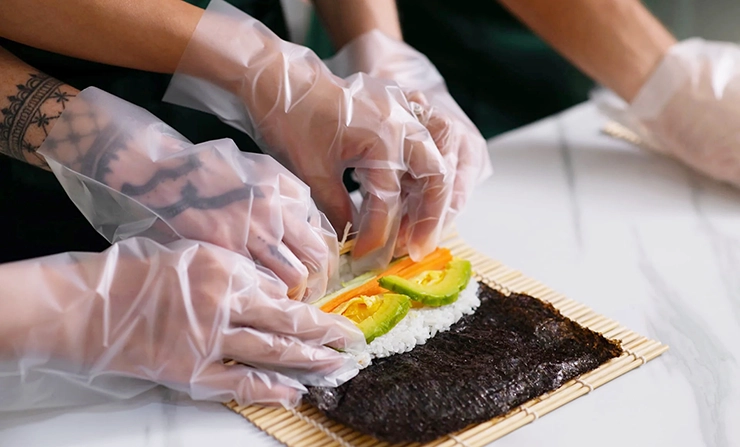
In today’s haute cuisine and premium lifestyle industry, attention to detail has become more than a standard — it is a language of status. How a chef looks, how they work, what materials they use — all of this forms the visual culture of luxury-level gastronomy. And even such a seemingly utilitarian element as gloves has now evolved into a full-fledged accessory, reflecting the philosophy of the kitchen, the level of the establishment, and the chef’s aesthetic mindset.
From simple protection to a symbol of professionalism, gloves have undergone an evolution comparable to that of fashion itself: from functionality to style, from necessity to conscious choice.
Polyethylene Gloves: The Basic Level
The simplest and most accessible option is disposable polyethylene gloves. Their main purpose is quick and inexpensive hand protection when handling food. They are lightweight, thin, almost weightless, and ideal for short-term tasks: portioning, working with prepared ingredients, and auxiliary operations.
However, in the context of haute cuisine, their role is more technical than aesthetic. They lack a close fit, quickly lose shape, and do not give the chef a sense of control. In luxury gastronomy, such gloves can be compared to a basic uniform without individuality — a necessary minimum, but not an expression of style.
Vinyl Gloves: A Neat Compromise
The next level is vinyl gloves. They are thicker, more resistant to tearing, and provide a slightly greater sense of confidence in work. In the food industry, they are often used for less intensive processes where cleanliness and hygiene are important, but maximum tactile sensitivity is not required.
From an aesthetic standpoint, vinyl looks more structured: it is less “medical” in appearance and sits more softly on the hand. However, it still remains a compromise between comfort and functionality. For mid-range and premium restaurants, it is a working tool, but not part of the chef’s personal image.
Latex Gloves: A Classic of Tactility and Control
Latex marked an important milestone in the development of kitchen culture. These gloves fit tightly, creating the effect of a “second skin.” The chef feels the product almost directly while maintaining a high level of hygiene.
In haute cuisine, this is no longer just protection, but a tool of precision. Latex gloves allow chefs to work with delicate ingredients without losing finger sensitivity, which is especially important in author-driven gastronomy.
Yet latex also has its own aesthetic: it is associated with the classical professional kitchen, where discipline, control, and clean lines matter. Visually, it already resembles part of a uniform — neat, strict, almost engineered. It is here that gloves first become part of the chef’s image.
Nitrile Gloves: The Modern Standard of Haute Cuisine
Nitrile gloves have become a symbol of the new generation of gastronomic industry. They are stronger, more puncture-resistant, hypoallergenic, and provide a high level of protection even under intensive use.
But most importantly, they are aesthetically universal. Often matte and perfectly fitted, they create a sense of cleanliness, precision, and technological sophistication. Visually, such gloves integrate seamlessly into a luxury kitchen environment where every detail is refined to perfection.
In fashion terms, nitrile can be compared to minimalist premium clothing: it does not distract but emphasizes movement, gesture, and professionalism. A chef wearing such gloves appears composed and modern, while the kitchen itself takes on an almost fashion-driven character.
Gloves as an Accessory of Haute Cuisine
If gloves were once considered purely a hygiene tool, today they have become part of the chef’s visual code. Like carefully chosen accessories in fashion, gloves shape perception even before the cooking begins.
In high-end restaurants, where every plate is a performance, the appearance of the team matters as much as the taste of the dish. The color, density, and texture of gloves can become part of the overall concept — from sterile bright aesthetics to dramatic dark accents in open kitchens.
Luxury in Details: A New Gastronomic Aesthetic
Modern haute cuisine increasingly borrows the language of fashion. Silhouettes, textures, tactile sensations, and visual harmony all matter. Gloves have become part of this system — not just protection, but an extension of the chef’s hand, a tool of precision, and part of a visual performance.
This is the essence of new culinary luxury: it is expressed not in excess, but in the refinement of details. Even such a simple element as gloves becomes a marker of level, taste, and philosophy.
Functionality as a New Form of Style
The evolution of gloves in the food industry reflects a broader shift — the blurring of boundaries between function and aesthetics. From simple polyethylene models to advanced nitrile solutions, each stage adds not only practicality but also visual identity.
In today’s world, where haute cuisine is part of the cultural industry and the chef is a bearer of style, even gloves begin to “speak.” And their language is one of precision, cleanliness, and a new, quiet form of luxury.
The post Kitchen Gloves in Haute Cuisine: How a Simple Tool Became a Luxury Chef’s Style Statement appeared first on The Fashiongton Post.