
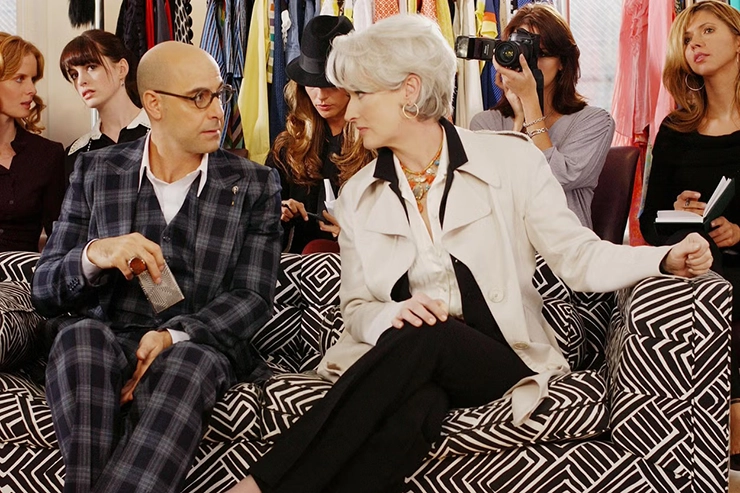
There are screen styles that never age — not because they were “fashionable,” but because they were precise from the very beginning. Nigel, played by Stanley Tucci in The Devil Wears Prada, is exactly that kind of case. He exists within the frame with the rare confidence of someone who is not trying to be part of fashion, because he has long since become part of it.
Against the chaotic energy of the editorial office, where clothing often functions as a statement, his style feels almost like a pause. And today, that pause reads as luxury.
Elegance Through the Absence of Excess
Nigel is one of the most underrated male characters in films about the fashion industry. While attention naturally gravitates toward Andy’s visual transformation and the impeccable architecture of Miranda Priestly’s wardrobe, he remains a figure of an entirely different order. He has no need to impress — and that is precisely what makes him so convincing.
His wardrobe is built not around fashion as an idea, but around fashion as discipline. These are the clothes of someone who works inside the system and understands it from within, yet has no need to demonstrate his belonging to it.
The Dark Suit as a Form of Control
The foundation of his look is a series of suits with strict, almost architectural lines. Most often they appear in deep shades of black, graphite, and navy. The jacket holds its shape without stiffness, with softly structured shoulders and a clean silhouette that never strives for drama, yet always sustains it.
The trousers follow the same logic: straight-cut, precisely tailored in length, without deliberate cropping or excessive volume. They do not compete for attention; instead, they create a vertical line — the kind of visual stability that makes the entire look feel composed.
His shirts are almost always solid-colored. White remains the essential point of reference, while pale blue appears as a softer tonal shift, but in both cases the effect is one of complete visual quietness. There are no details in this wardrobe that demand interpretation.
A Wardrobe Without Visible Effort
What stands out most in Nigel’s style is the complete absence of any attempt to “build an outfit.” Everything looks as though the clothes were never consciously assembled, but simply always existed as a natural system.
The shirt sits perfectly beneath the jacket every time. The cuffs appear only enough to emphasize precision rather than create an accent. The suit does not fight against the body — it follows it. This is a rare kind of visual discipline in which clothing never becomes the event itself, but remains the structure behind it.
Glasses as an Intellectual Accent
Nigel’s glasses are one of the defining elements of his appearance, instantly shaping how the character is perceived. In the film, he wears thick horn-rimmed frames with a strong, pronounced shape that immediately gives his image visual weight.
There is no decorative lightness to them, and no attempt to soften the look. On the contrary, the frames add sharpness, concentration, and an almost architectural sense of control to the face. They are not an accessory that merely “completes the style,” but a detail that fixes the viewer’s perception of the character: attentiveness, authority, and professional precision.
That is exactly why the glasses remain one of the most memorable parts of the look — not because of elegance, but because of character.
Shoes and Accessories as an Extension of Silence
The footwear in this wardrobe is entirely free from the desire to announce itself. Classic dark leather shoes, without aggressive shine or decorative details, complete the silhouette the same way silence completes a perfectly delivered sentence.
Accessories are reduced to the bare minimum: a restrained watch, occasionally a leather briefcase without visible status markers. These are not accents, but tools — and that is precisely why they work.
Why the Look Feels Modern Again
At a moment when people are increasingly tired of visual noise and performative dressing, Nigel’s style returns to relevance almost naturally. It does not propose a new aesthetic — it reminds us of a foundational one.
A dark suit, a white shirt, the clean line of a coat, precise footwear, and the absence of unnecessary signals create not an image of fashion, but an image of control.
And perhaps that is the look’s greatest quality: it never tries to be noticeable. It simply looks right — and that turns out to be enough.
The post How to Dress Like Stanley Tucci in The Devil Wears Prada appeared first on The Fashiongton Post.