
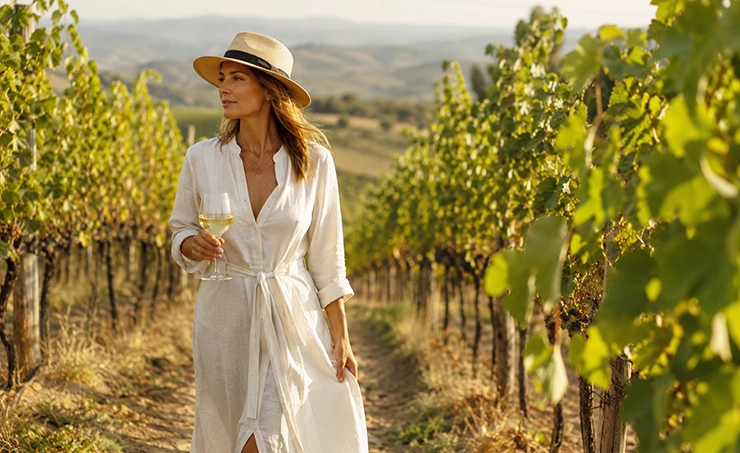
The worlds of haute couture and fine wine have always existed in the same orbit—both require patience, obsession with detail, and a reverence for craft that cannot be rushed. But in recent years, the two have become inseparable. Luxury fashion houses are quietly acquiring vineyards, and the trend is accelerating. For the discerning buyer, owning a vineyard is no longer just about wine. It is the ultimate couture accessory—a signal that taste extends beyond the wardrobe into the land itself.
Chanel led the charge decades ago, acquiring Château Rauzan-Ségla in Margaux and Château Canon in Saint-Émilion. Not as side projects, but as extensions of the brand’s DNA. The same attention to stitching and proportion is now applied to viticulture—cover crops, harvest timing, barrel selection. The parallel between a Chanel jacket and a Grand Cru is impossible to ignore. Both require thousands of small decisions, each one invisible to the casual observer but essential to the final product.
Louis Vuitton Moët Hennessy has built an empire on this philosophy. Dom Pérignon, Krug, Ruinart—these are not just wine labels. They are expressions of a luxury house that understands the importance of terroir in the same way it understands the importance of leather. The acquisition of Clos des Lambrays in Burgundy signaled a shift: LVMH is not just selling wine; it is selling access to land that cannot be replicated. And that is precisely what makes it irresistible to the discerning consumer.
Brunello Cucinelli, the king of cashmere, has taken a different but equally telling approach. His vineyard in Umbria is not about scale. It is about philosophy. The wine reflects the same values as his clothing—slow, deliberate, respectful of tradition. For Cucinelli, the vineyard is an extension of his brand narrative. It says: “We care about the same things in every part of life.” This consistency is precisely what the serious buyer craves.
What is driving this trend? First, diversification. Vineyards have proven to be remarkably stable assets. They do not fluctuate like stocks. They do not disappear like digital currencies. They produce something tangible, physical, and increasingly scarce. As climate change reshapes viticulture globally, established estates in prime regions are becoming even more valuable. Acquiring one is not just a luxury—it is a hedge against the future.
Second, legacy. The modern collector is no longer content to collect wine. They want to produce it. They want to attend tastings where they pour their own label. They want to serve their own estate at private dinners. The vineyard becomes a conversation starter that no watch or car can match. It speaks of patience, commitment, and a connection to the earth—values that resonate deeply in an age of instant gratification.
Third, the fashion connection is intrinsic. Both industries are built on craftsmanship, authenticity, and the passage of time. A couture gown takes hundreds of hours to construct. A great wine takes decades to mature. For the owner who already has everything, the vineyard is the natural progression—a wearable legacy that extends beyond the body into the land itself.
The wine world is also learning from fashion. The rise of “luxury experiences” has transformed vineyard visits into immersive brand encounters. Guests at Château Canon are not just tasting wine; they are entering a curated world of Chanel elegance. The tasting room becomes a showroom. The cellar becomes a gallery. The wine becomes a product that tells a story far beyond its vintage.
For the aspiring vineyard owner, the entry point is surprisingly accessible. Established estates in Tuscany or Bordeaux are available for purchase at prices that compare favorably to a prime Manhattan apartment. But the real value lies not in the price tag, but in the exclusivity. A vineyard with a recognized name and a stable production history offers immediate social currency. It says: “I did not buy this; I was chosen.”
Fashion houses understand this. They do not acquire vineyards for profit margins. They acquire them for brand elevation. The same logic applies to the private buyer. A vineyard is not an investment in wine. It is an investment in belonging.
The future will see more of this convergence. As sustainability becomes a critical issue for both industries, vineyards offer a visible commitment to land stewardship. Organic and biodynamic practices align perfectly with the values of luxury consumers who care about provenance. The vineyard becomes a statement of ethics, not just aesthetics.
When you pour a glass from your own estate, you are not just serving wine. You are serving your values. You are serving your patience. You are serving your taste. And in the world of couture and Cabernet, that is the most valuable currency of all.
The post When Couture Meets Cabernet: Why Fashion Houses Are Investing in Vineyards appeared first on The Fashiongton Post.