
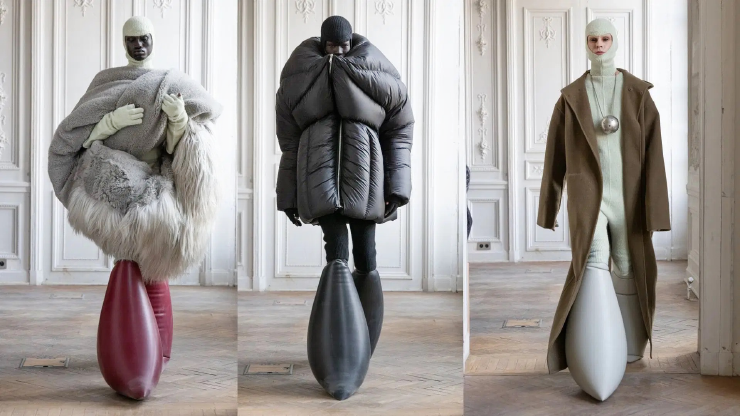
Rick Owens (born November 18, 1961) is an American fashion designer known for his avant-garde aesthetic, architectural silhouettes, and a dark, moody vision that has redefined contemporary fashion. Emerging from the underground scene in Los Angeles, Owens built a cult following before transitioning to the global stage, where his eponymous brand became synonymous with a unique fusion of grunge, minimalism, and high fashion. His work is deeply influenced by subcultures, art, and brutalist architecture, creating a visual language that stands apart from mainstream luxury fashion.
Raised in Porterville, California, Owens moved to Los Angeles to study fine arts at Otis College of Art and Design. However, he left before completing his degree, shifting his focus to pattern-making and draping, which he learned at Los Angeles Trade-Technical College. This decision marked the beginning of his hands-on approach to design, as he honed his skills through practical experience rather than conventional academic training. Owens initially worked for knockoff designers in the garment industry, which gave him an understanding of construction and production, albeit through a commercial and often unglamorous lens. It was during this period that he began crafting his own designs, laying the foundation for the raw, deconstructed aesthetic that would later define his brand.
In 1994, Owens launched his own label from a small operation in Los Angeles, producing pieces that combined distressed leather, asymmetry, and elongated proportions. His designs resonated with an underground audience drawn to his rebellious and anti-establishment sensibility. The early collections, marked by a restrained color palette dominated by black, gray, and muted earth tones, reflected his artistic influences, ranging from Renaissance sculpture to punk rock. His breakthrough came in 2001 when Vogue’s influential editor Anna Wintour noticed his work. This recognition led to a pivotal moment in his career—a sponsorship deal with the Italian fashion group EBA, which enabled him to present his collections on the Paris runway. In 2003, Owens relocated to Paris, where he continued to build his brand and further refine his signature aesthetic.
Owens’ runway presentations are known for their theatricality, often featuring unconventional models, dramatic set designs, and performance art elements that elevate his shows beyond traditional fashion presentations. He challenges conventional beauty standards, frequently casting a diverse array of individuals who embody the ethos of his brand rather than conforming to industry norms. His collections blur the line between fashion and wearable art, with exaggerated proportions, innovative fabric treatments, and sculptural tailoring playing a central role in his design language. His footwear, particularly the iconic Geobasket sneakers and exaggerated platform boots, has become a staple in both high fashion and streetwear, influencing an entire generation of designers.
Beyond his clothing and footwear, Owens has expanded his creative vision into furniture design, creating brutalist-inspired pieces that echo the stark, monolithic forms seen in his fashion. His commitment to a singular aesthetic extends to every aspect of his brand, from store interiors to packaging, reinforcing a world that is unmistakably his own. His influence extends beyond fashion into music, contemporary art, and architecture, making him one of the most distinctive and enduring voices in the industry.
Throughout his career, Owens has maintained a strong partnership with his wife and muse, Michèle Lamy, a French-born artist and entrepreneur whose eccentric style and creative sensibilities complement his own. Together, they have built an empire that transcends traditional fashion branding, cultivating a fiercely loyal fanbase that appreciates the authenticity and intellectual depth behind his work. Despite his avant-garde approach, Owens has achieved commercial success, with a devoted clientele that includes celebrities, musicians, and fashion insiders who embrace his unique vision.
Owens’ work embodies a paradox—his designs are at once aggressive and elegant, raw and refined, dystopian yet deeply romantic. His ability to merge opposites, crafting garments that feel both ancient and futuristic, has cemented his place as a true visionary in contemporary fashion. With each collection, he continues to push boundaries, proving that fashion can be more than just clothing—it can be a philosophy, a lifestyle, and a statement of artistic intent.
The post Rick Owens appeared first on The Fashiongton Post.