
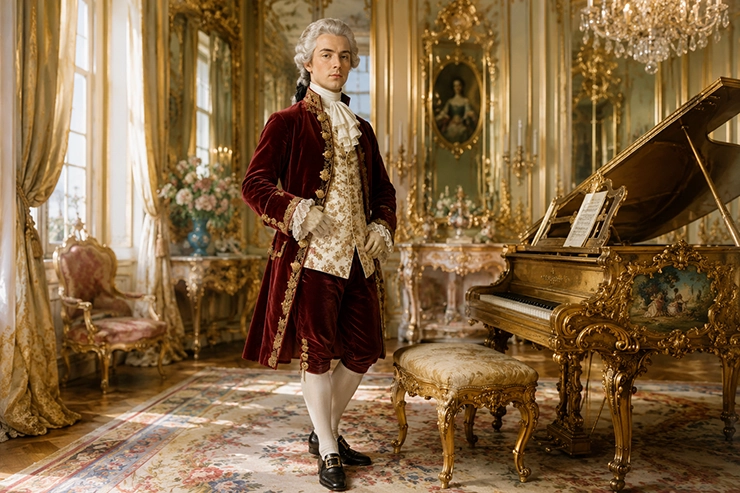
When we imagine composers, we usually hear their music rather than see their clothing. Yet the eras they lived in dictated not only sound but also a visual code — silhouettes, fabrics, and details that today read as a complete aesthetic system. Velvet, brocade, lace, high collars, and the military precision of tailcoats — the wardrobe of classical music geniuses was a direct extension of their status, time, and country.
Wolfgang Amadeus Mozart — Viennese Rococo Elegance
Mozart lived in late 18th-century Austria, during the refined world of Rococo fashion, where clothing was almost theatrical. As a court musician, his wardrobe would have included cropped silk and velvet coats in rich tones such as burgundy, deep blue, and emerald green.
White lace cuffs and jabots were essential — decorative chest elements emphasizing status and refinement. Knee-length breeches were worn with silk stockings, and leather shoes with buckles completed the ensemble. Powdered wigs were still part of court etiquette and likely appeared in formal settings.
His style reflects the Rococo spirit itself: light, decorative, and exquisitely ornate.
Ludwig van Beethoven — The Rise of Bourgeois Sobriety
https://fashiongtonpost.com/wp-content/uploads/2026/06/Ludwig-van-Beethoven-Für-Elise.mp3
Beethoven lived through the transition from Classicism to the more restrained bourgeois fashion of the early 19th century. His wardrobe reflected this shift: less decoration, more structure.
He typically wore dark tailcoats — often black or deep navy — paired with white high-collared shirts and waistcoats. Compared to Mozart, ornamentation nearly disappears, replaced by restraint and severity.
Wigs were falling out of fashion by this time, and Beethoven is often depicted with natural, sometimes unkempt hair — a detail that became part of his iconic image. His style mirrors early Romanticism: inner intensity rather than external embellishment.
Johann Sebastian Bach — German Baroque Discipline
Bach lived in Baroque-era Germany, where clothing emphasized order and hierarchy. His wardrobe was typical of a Protestant environment: dark, structured coats with minimal decoration.
He is often portrayed in a dark tailcoat with a white collar and a neatly tied neckcloth. Powdered wigs were still in use, though more restrained compared to French aristocratic fashion.
Bach’s look reflects discipline and structure — the same principles that define his fugues and contrapuntal mastery.
Pyotr Ilyich Tchaikovsky — Russian Romantic Elegance
Tchaikovsky lived in the 19th century, when men’s fashion had become closer to what we recognize today. In Russia and across Europe, he wore formal suits: dark tailcoats, waistcoats, white shirts, and ties or bow ties.
His style was refined and intellectual rather than courtly. Well-tailored, understated suits reflected the spirit of late Romanticism.
In many ways, Tchaikovsky already resembles the modern image of classical elegance: the dark suit as a symbol of intellect and cultural authority.
Antonio Vivaldi — Venetian Theatrical Spirituality
https://fashiongtonpost.com/wp-content/uploads/2026/06/Vivaldi-Violin-Concerto-in-A-Minor-RV-356.mp3
Vivaldi lived in 18th-century Venice — a city where music, theatre, and the church were deeply intertwined. As a priest and composer, he wore clerical garments: black cassocks, long robes, and strict collars.
Yet Venice added its own theatrical sensibility. Even within clerical dress, fabrics were softer, silhouettes more fluid, and the overall aesthetic less rigid than in Northern Europe.
His appearance embodies a fusion of spirituality and performance — where even strict clothing becomes part of artistic expression.
Eras Frozen in Fabric
Placed side by side, these composers reveal a deeper truth: their music and their clothing belong to the same system of cultural language. Mozart’s Rococo elegance, Bach’s Baroque discipline, Beethoven’s transitional austerity, Tchaikovsky’s Romantic refinement, and Vivaldi’s Venetian spirituality are not only musical styles — they are also textures, silhouettes, and gestures translated into fabric.
In this sense, the wardrobe of classical music geniuses reads like a fashion history that predates modern fashion itself — when clothing already functioned as a language of status, identity, and artistic identity.
The post The Wardrobe of Classical Music Geniuses: How Mozart, Beethoven, Bach, Tchaikovsky, and Vivaldi Dressed appeared first on The Fashiongton Post.