
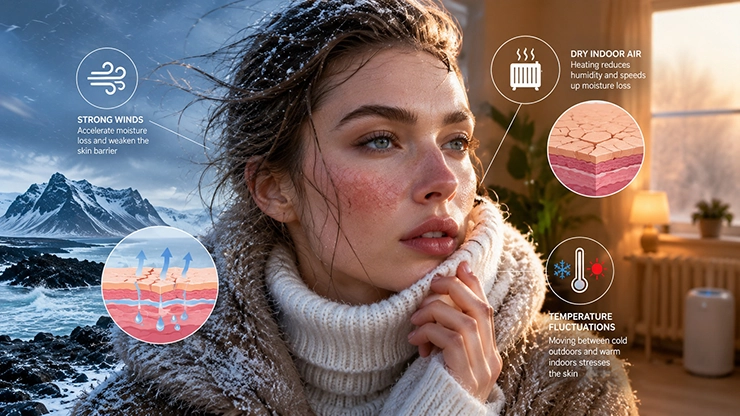
Iceland is famous for its volcanic landscapes, glaciers, geothermal springs, and dramatic natural beauty. However, the country’s climate presents a serious challenge not only for travelers but also for the skin. Constant winds, low temperatures throughout much of the year, and dry air can quickly compromise the skin’s protective barrier, leading to dehydration, flaking, and increased sensitivity.
It is no surprise that Icelanders place a strong emphasis on hydration and skin barrier repair. Their approach to skincare is not based on complicated, multi-step routines but rather on effective products that help maintain healthy skin under demanding environmental conditions.
Why Iceland’s Climate Has Such a Strong Impact on the Skin
Many people assume that cold temperatures are the biggest skincare challenge in northern countries. In reality, the main enemy of the skin in Iceland is the combination of several environmental factors.
Strong winds accelerate moisture loss from the skin’s surface. Even on relatively mild days, the face is exposed to constant airflow that weakens the skin’s natural protective barrier.
During winter, the problem becomes even more pronounced due to dry indoor air. Heating systems significantly reduce humidity levels, causing the skin to lose moisture more rapidly. As a result, many people experience tightness, redness, and flaking. In addition, frequent transitions between cold outdoor temperatures and heated indoor environments place extra stress on the skin, particularly for those with sensitive complexions.
The Main Priority: Strengthening the Skin Barrier
Modern dermatologists increasingly emphasize the importance of maintaining a healthy skin barrier. This protective layer helps retain moisture and shields the skin from external irritants.
For people living in Iceland, supporting the skin barrier is one of the most important skincare goals. As a result, special attention is given to products containing ingredients that help reinforce and restore this protective layer.
Among the most beneficial ingredients are:
Ceramides
Squalane
Fatty acids
Panthenol
Niacinamide
Colloidal oatmeal
These ingredients help reduce dryness and improve the skin’s ability to withstand wind and cold weather.
Hydration Should Be Layered
In a dry climate, a moisturizer alone is often not enough. Effective skincare usually involves multiple layers of hydration. After cleansing, it is beneficial to apply a hydrating serum containing ingredients such as hyaluronic acid, glycerin, or betaine. These compounds attract and retain moisture within the skin.
The next step is a richer moisturizer that creates a protective barrier and helps prevent moisture loss. In northern climates, creams with richer textures tend to perform particularly well. Unlike lightweight gels that are popular in warmer regions, richer formulations provide long-lasting protection against dehydration.
Gentle Cleansing Instead of Harsh Products
One of the most common skincare mistakes is using cleansers that strip the skin of its natural oils. When the skin barrier is already under stress from environmental conditions, harsh cleansing products can make the situation worse.
For dry and windy climates, the following options are generally better suited:
Cream cleansers
Cleansing milk
Gentle sulfate-free gels
Cleansing balms
After washing, the skin should not feel tight or uncomfortable. If it does, it may be time to reconsider the cleansing product being used.
Facial Oils Are Making a Comeback
Despite their sometimes controversial reputation in the beauty industry, facial oils can be extremely beneficial in northern climates. A small amount of oil applied over a moisturizer can help reduce moisture loss and provide an additional layer of protection against harsh winds.
Particularly popular options include:
Rosehip oil
Jojoba oil
Argan oil
Squalane oil
It is important to remember that oils do not replace hydration; instead, they help seal in existing moisture.
Don’t Forget Sunscreen
Many people mistakenly believe that sun protection is unnecessary in northern countries. However, ultraviolet radiation affects the skin even on cloudy days. During winter, sunlight reflected from snow and ice can further increase UV exposure. For this reason, daily use of a sunscreen with SPF 30 or higher remains an essential part of skincare throughout the year.
Pay Special Attention to Lips and the Eye Area
The delicate skin of the lips and around the eyes is often the first to suffer from cold and wind exposure. These areas can quickly become dry, irritated, or prone to cracking. For extra protection, richer products containing ingredients such as shea butter, lanolin, panthenol, and ceramides are highly recommended. Many people living in northern climates keep a lip balm with them at all times and reapply it several times throughout the day.
Nighttime Skincare Matters
The skin undergoes much of its repair and recovery process while we sleep. For this reason, evening skincare routines in Iceland are often more intensive than morning routines. Before bed, it can be beneficial to use restorative creams and overnight masks formulated with ceramides, peptides, and soothing ingredients. Even using a hydrating overnight mask once or twice a week can noticeably improve the condition of the skin during the colder months.
Interestingly, Icelanders rarely pursue complicated ten-step skincare routines. Instead, a minimalist approach built around a few high-quality products remains the preferred strategy.
Gentle cleansing, effective hydration, barrier repair, and daily sun protection are the core principles that help maintain healthy skin despite strong winds, low temperatures, and dry air.
Ultimately, the best skincare routine for Iceland’s climate is not about following every new trend. It is about consistently using products that support the skin’s natural protective functions and help it adapt to one of the most demanding environments.
The post Best Skincare for Iceland’s Dry and Windy Climate appeared first on The Fashiongton Post.