
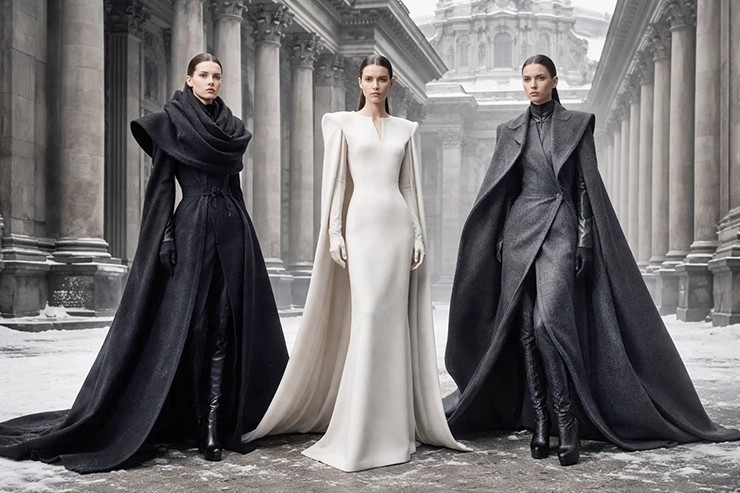
There are cities that impress, and there are cities that linger. St. Petersburg belongs firmly to the latter. Its grandeur is not loud but atmospheric—an interplay of imperial architecture, diffused northern light, and an almost cinematic melancholy. For American designers working at the highest levels of luxury fashion, this city has become an unlikely but powerful source of inspiration.
From the sculptural austerity seen in Rick Owens’ collections to the restrained elegance of The Row, echoes of St. Petersburg’s visual language are increasingly visible on Western runways. This is not about literal references or folkloric clichés—it’s about mood, proportion, and the quiet drama that defines both the city and contemporary luxury fashion.
The Architecture of Power and Restraint
St. Petersburg’s architectural identity is built on contrast. Baroque opulence sits alongside neoclassical symmetry, while Soviet minimalism adds a stark, almost brutalist counterpoint. The result is a city that feels simultaneously ornate and restrained—a duality that resonates deeply with modern luxury design.
American designers, particularly those working in the high-end segment, have been translating this tension into clothing. Structured silhouettes, elongated lines, and a monochromatic palette often mirror the city’s facades. Think of garments that feel like architecture—coats that fall like columns, dresses that echo the vertical rhythm of palace windows.
Rick Owens, for instance, has long explored themes of monumentality and austerity. His use of heavy fabrics, sculptural draping, and muted tones recalls the imposing presence of St. Petersburg’s historic buildings under a winter sky. There’s a sense of permanence in his work, much like the city itself—timeless, slightly severe, yet undeniably captivating.
Light, Shadow, and the Northern Palette
One of the most distinctive features of St. Petersburg is its light. The famous “White Nights” of summer bathe the city in a soft, almost surreal glow, while winter brings a subdued palette of greys, blues, and silvers. This unique lighting has a profound effect on how the city is perceived—and, by extension, how it inspires design.
In recent seasons, American luxury brands have embraced a similarly nuanced color story. Instead of bold, saturated hues, collections often lean toward tonal dressing: layers of ivory, charcoal, slate, and muted metallics. The effect is understated but deeply sophisticated.
The Row, known for its minimalist aesthetic, exemplifies this approach. Its collections frequently feature soft, neutral tones that feel almost atmospheric rather than decorative. There is a quiet luxury in these choices—a refusal to shout, opting instead for subtlety and depth. It’s a philosophy that aligns closely with the visual experience of walking through St. Petersburg at dusk, when the city seems to dissolve into gradients of light and shadow.
Melancholy as a Design Language
Beyond its physical beauty, St. Petersburg carries an emotional weight. There is a pervasive sense of introspection—a kind of cultivated melancholy that has inspired writers, artists, and now, fashion designers.
This emotional dimension is increasingly relevant in luxury fashion, where storytelling and mood are as important as craftsmanship. Designers are moving away from overt displays of wealth toward pieces that evoke feeling and narrative.
In this context, St. Petersburg offers a rich source of inspiration. Its history, marked by grandeur and upheaval, creates a layered atmosphere that designers translate into clothing with depth and complexity. Long, flowing silhouettes, heavy textures, and subdued detailing can all be seen as expressions of this mood.
For American designers, particularly those catering to a global luxury audience, this emotional resonance adds value. It transforms garments from mere objects into experiences—something that today’s discerning consumers actively seek.
From Imperial Grandeur to Modern Minimalism
What makes St. Petersburg particularly compelling is its ability to bridge extremes. The city’s imperial past is evident in its palaces and cathedrals, yet it also embodies a distinctly modern sensibility through its clean lines and open spaces.
This duality is mirrored in the work of many American luxury brands. Collections often juxtapose rich materials—such as velvet, cashmere, and silk—with minimalist cuts and understated construction. The result is a kind of “controlled opulence,” where luxury is expressed through quality and detail rather than excess.
Designers are increasingly interested in this balance. It allows them to appeal to a clientele that values sophistication over spectacle. In a market saturated with fast fashion and logo-driven branding, the quiet authority of St. Petersburg-inspired design feels both fresh and timeless.
The Influence of Cultural Memory
St. Petersburg is not just a visual experience; it is a repository of cultural memory. Literature, ballet, and classical music all contribute to its identity, creating a multidimensional source of inspiration.
American designers often draw on these cultural references in subtle ways. A collection might evoke the fluidity of ballet through soft draping, or the structure of classical music through rhythmic tailoring. These influences are rarely explicit, but they add layers of meaning that elevate the final product.
For luxury brands, this depth is crucial. It differentiates their offerings in a competitive market and provides a narrative that resonates with consumers on an intellectual as well as an aesthetic level.
Why This Matters for the Future of Luxury
The growing influence of St. Petersburg on American luxury fashion reflects a broader shift in the industry. Today’s consumers are increasingly drawn to authenticity, craftsmanship, and storytelling. They are less interested in overt displays of wealth and more attuned to nuance and meaning.
St. Petersburg, with its complex identity and understated beauty, offers exactly this kind of inspiration. It encourages designers to think beyond trends and to create pieces that feel enduring and emotionally resonant.
For brands operating in the luxury сегмент, this approach has clear commercial advantages. It aligns with the values of high-net-worth consumers, who prioritize quality and uniqueness. It also provides rich content opportunities for digital platforms, enhancing SEO performance through storytelling that engages and retains readers.
A City That Dresses the Imagination
Ultimately, the influence of St. Petersburg on American designers is not about replication but interpretation. It’s about capturing a feeling—a sense of quiet grandeur, of beauty tinged with melancholy—and translating it into clothing that speaks to a global audience.
As luxury fashion continues to evolve, cities like St. Petersburg will play an increasingly important role. They offer a depth of inspiration that cannot be manufactured, only experienced and reimagined.
In the hands of visionary designers, the city’s nights—softly lit, endlessly atmospheric—become more than a backdrop. They become a language, one that defines the future of luxury style.
The post St. Petersburg Nights: How Russia’s Northern Capital Inspires American Luxury Designers appeared first on The Fashiongton Post.