
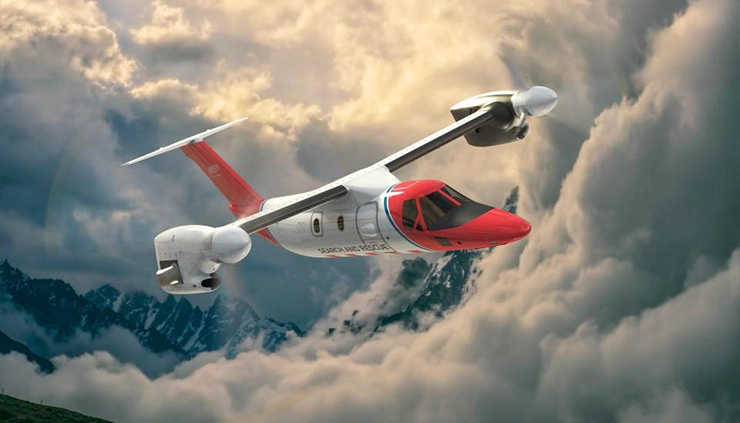
For decades, the ultra-wealthy have faced a choice: the helicopter or the jet. One offers vertical takeoff and access to tight spaces; the other provides speed, range, and cabin comfort. The tiltrotor eliminates the need to choose.
By combining the vertical takeoff and landing capabilities of a helicopter with the speed and range of a turboprop aircraft, tiltrotors represent the next frontier in private aviation. They take off vertically, transition to forward flight, and cruise at speeds of up to 300 knots—significantly faster than any helicopter on the market. They cover distances that would require a fuel stop in a rotorcraft and land at airports that jets cannot access.
For the ultra-wealthy traveler, this versatility translates into freedom. A tiltrotor can depart from a city helipad, fly non-stop to a remote island, and land on a private estate without requiring a runway. It eliminates the need for multiple aircraft and simplifies logistics, saving time and reducing operational complexity.
The cabin experience is equally transformative. Tiltrotors offer the spaciousness and comfort of a light jet, with stand-up headroom, large windows, and configurable seating. Some models feature full lavatories, galley spaces, and premium soundproofing that rivals the quietest business jets. The noise levels, historically a concern with vertical takeoff aircraft, have been significantly reduced in recent designs.
Leonardo AW609: The Pioneer
The AW609 is the first civilian tiltrotor to enter the market, and it remains the benchmark for the category. With a range of over 1,000 nautical miles and a service ceiling of 25,000 feet, it offers capabilities that no helicopter can match. Its twin-engine configuration provides the redundancy required for overwater operations, and its cabin can be configured for executive transport, medical evacuation, or utility missions.
For the ultra-wealthy buyer, the AW609 represents the ultimate compromise between performance and prestige. The cabin is pressurized, allowing it to fly above weather systems, and the interior can be customized with premium leather, wood finishes, and advanced entertainment systems. It is not just an aircraft; it is a statement of intent.
Bell V-280 Valor: The Future of Military-Grade Luxury
Originally developed for the U.S. Army’s Future Vertical Lift program, the V-280 Valor is now being explored as a platform for VIP transport. Its unique configuration features fixed engines and tilting rotors, which reduce mechanical complexity and improve stability in forward flight. The cabin is designed for rapid entry and exit, with a wide opening that accommodates stretchers or oversized cargo.
For the ultra-wealthy owner, the V-280 offers the assurance of a design that has been rigorously tested for military applications. Its speed and range exceed that of the AW609, making it suitable for longer missions. While it is not yet available for civilian purchase, its potential for luxury conversion is significant.
Joby Aviation S4: The Electric Contender
The S4 represents the next generation of vertical takeoff technology. It is fully electric, with six rotors that tilt forward for cruise flight. The cabin seats four passengers plus a pilot, and the aircraft is designed to be quiet enough for urban operations. While its range is currently limited to around 150 miles, it is ideal for short-haul connections between cities and suburbs.
For the environmentally conscious buyer, the S4 offers a carbon-neutral alternative to traditional helicopters. Its operating costs are significantly lower, and its maintenance requirements are minimal. As battery technology improves, the S4 could become a viable option for longer trips, positioning it as a disruptor in the luxury travel market.
The Tiltrotor Advantage
Owning a tiltrotor is about more than convenience—it is about versatility. The ability to depart from a helipad, transition to high-speed cruise, and land at a regional airport without the need for a ground transfer is a significant competitive advantage. For business leaders, this means more time in productive environments and less time in transit.
The maintenance and operating costs are higher than those of a helicopter, but for the ultra-wealthy, they are a manageable expense. The real value lies in the time saved and the freedom gained. The tiltrotor offers a level of flexibility that no other aircraft can provide.
The Future of Vertical Flight
The tiltrotor is no longer an experimental concept. It is a reality waiting to be experienced. Whether it is the AW609, the V-280, or the S4, each model offers a unique approach to the problem of vertical flight. The AW609 is the established leader, the V-280 is the military-grade contender, and the S4 is the sustainable innovator.
For the ultra-wealthy traveler, the choice depends on the mission. The AW609 is ideal for those who need range and reliability. The V-280 offers military-grade durability and speed. The S4 provides a quiet, emission-free option for short-haul routes.
In a world where time is the only non-renewable resource, the tiltrotor is the ultimate tool. It expands the horizon of what is possible in private travel, offering a solution that combines the best of both helicopters and jets. The future of luxury aviation is here—and it is vertical, fast, and unapologetically refined.
The post Beyond Helicopters: How Tiltrotors Are Redefining Ultra-Luxury Travel appeared first on The Fashiongton Post.