
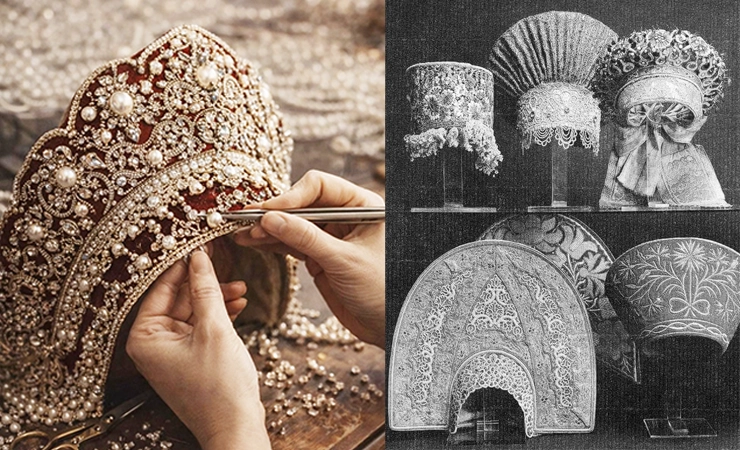
Kokoshnik is one of the most recognizable elements of traditional Russian costume, and today it is experiencing a new renaissance in global fashion. Until recently, it was perceived exclusively as a historical or folkloric headdress associated with folk celebrations and stage imagery. However, in recent seasons, designers have increasingly turned to it as a striking fashion accessory.
The reason for this interest is simple: contemporary fashion seeks to reinterpret cultural heritage and explore new forms of identity. With its expressive silhouette, ornamentation, and symbolism, the kokoshnik fits perfectly into this trend. It has become not just a reference to the past, but a full-fledged element of high fashion, visible on runways, in photo shoots, and on fashion enthusiasts not only in its country of origin, but also in the United States and Europe.
From Tradition to the Runway: How Kokoshnik Entered Global Fashion
The reinterpretation of the kokoshnik began with designers’ interest in historical forms of Russian headwear. In haute couture collections, it started appearing in various interpretations: from minimalist metal constructions to richly decorated versions with stones and embroidery.
Many fashion houses use the silhouette of the kokoshnik as a foundation for creating modern accessories. It can be made of leather, metal, textiles, or even plastic, while preserving its recognizable arched shape. Thanks to this, the kokoshnik is no longer solely an ethnographic object, but a universal fashion code understood by an international audience.
Today, it can be seen not only on the runway but also in street style across major cities—from New York to Paris. It has become part of the visual language of contemporary fashion, where tradition and experimentation coexist on equal terms.
How to Wear Kokoshnik Today: Modern Styling Approaches
The modern kokoshnik no longer requires traditional costume or a special occasion. It can be integrated into both everyday and evening looks if balance is handled correctly.
One of the most relevant approaches is pairing the kokoshnik with minimalist clothing. Simple dresses, clean-cut suits, or monochrome sets allow the accessory to become the focal point of the look. In this case, the kokoshnik functions as an artistic object rather than a costume element.
Another approach is incorporating it into evening styling. Paired with long dresses, open shoulders, and soft fabrics, it creates a sense of theatricality and high fashion. Such looks are often chosen for events, photo shoots, and red carpet appearances.
A bolder option is combining the kokoshnik with streetwear. Jeans, structured blazers, leather elements, or sporty silhouettes paired with a statement headpiece create a striking contrast. This approach is especially popular among young stylists and fashion bloggers today.
Kokoshnik as a Fashion Statement
For many designers, it has become a way to reinterpret traditional forms and demonstrate that cultural symbols can exist outside a museum context. In this sense, the kokoshnik becomes part of a global dialogue about fashion, identity, and cultural exchange.
It is important to note that its use in contemporary fashion often goes beyond a single culture. It is reimagined, adapted, and transformed while preserving its recognizable silhouette. This makes it a universal element that is easily understood by an international audience.
How to Choose and Adapt Kokoshnik to Your Style
When choosing a kokoshnik, it is important to consider not only its appearance but also the overall style of your wardrobe. For minimalist looks, simple forms without excessive decoration work best. They create a clean accent without overwhelming the outfit.
If your style is more expressive, you can opt for models with decorative elements such as embroidery, stones, or metal details. These versions are suitable for evening outings and special occasions.
Proportions also matter. A kokoshnik with a high silhouette visually elongates the look and makes it more dramatic, while more compact versions appear softer and more versatile.
Kokoshnik in a Global Fashion Context
Today, a kokoshnik has become part of a broader trend—the return of historical forms in modern fashion. Designers around the world are turning to national costumes, reinterpreting them in a contemporary context.
In this sense, the kokoshnik holds a special place due to its expressiveness and recognizability. It adapts easily to different styles and becomes a bridge between tradition and modernity.
For American audiences, it is often perceived as an exotic yet aesthetically appealing object, while for Russian audiences it represents a reinterpreted cultural symbol that moves beyond traditional perception.
Why Kokoshnik Is More Than a Trend
Interest in the kokoshnik cannot be reduced to a short-term fashion moment. It reflects deeper processes in the fashion industry: a desire for individuality, an interest in cultural roots, and the creation of unique visual codes.
In a modern wardrobe, it can play different roles—from a statement accessory to the central element of a look. Its versatility allows it to remain relevant regardless of seasonal trends. Today, a kokoshnik is an example of how a traditional element can become part of a global fashion system without losing its identity.
The post Kokoshnik Is Back in Fashion: How to Wear the Main Russian Accessory Today appeared first on The Fashiongton Post.