
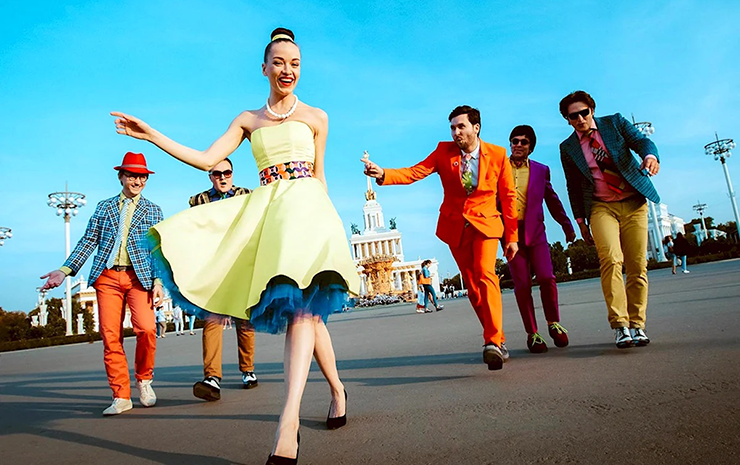
In the grey post-war Soviet Union, where conformity was the norm and individualism was discouraged, a subculture burst onto the scene with wild colors, American jazz, and rebellious flair. They were known as the “Stilyagi” — a group of stylish young men and women who defied social norms and embraced Western fashion and music during one of the most repressive periods of Soviet history. These “style hunters” or “hipsters,” as they might be loosely translated, became unlikely icons of resistance, challenging the monolithic culture imposed by the state.
Who Were the Stilyagi?
Emerging in the late 1940s and gaining momentum through the 1950s and early 1960s, the Stilyagi were Soviet youths who rejected the drab uniforms and collective identity of the Stalinist regime. The name “Stilyagi” derived from the Russian word “stil” meaning “style.” They stood out in streets and dance halls with their vibrant, Western-inspired outfits — brightly colored suits, narrow ties, oversized sunglasses, pointed shoes, and slicked-back hairstyles for men; pencil skirts, patterned dresses, bold makeup, and high heels for women.
What made the Stilyagi unique was not only their fashion but also their ideology — or rather, their counter-ideology. While not overtly political, their obsession with American and Western European culture was, in itself, a statement against Soviet puritanism. They danced to boogie-woogie and jazz, listened to banned records smuggled in from the West, and frequented underground gatherings where they could be themselves — often at great personal risk.
Fashion as a Form of Defiance
In a society where deviation from the norm could mean ostracism, surveillance, or worse, fashion became the Stilyagi’s weapon. Tailoring and altering clothing was an act of creativity and rebellion. Because Western goods were scarce or outright banned, they had to improvise: transforming military overcoats into mod-style jackets, dyeing fabric with beet juice or industrial chemicals to get vivid colors, and even stitching fake brand logos onto their clothes.
For Stilyagi, dressing up was a daily act of resistance. In a world dominated by brown, black, and grey, their look screamed individuality. While others blended in, they chose to stand out — flamboyantly.
Cultural Underground and Jazz Obsession
The Stilyagi were also defined by their love of Western music, particularly jazz and rock ‘n’ roll. At a time when such music was considered ideologically dangerous, listening to it was a radical act. They would copy bootleg records onto discarded X-ray films — a practice known as “music on the bones” — because vinyl was nearly impossible to get. These illicit records circulated hand-to-hand in underground networks, becoming both artifacts and symbols of resistance.
For many, Louis Armstrong, Benny Goodman, and later Elvis Presley became cultural heroes, embodying a freedom they themselves could only dream of. Dance halls became their sanctuaries. Jitterbug, swing, and the Charleston weren’t just moves — they were declarations of freedom.
Backlash and State Repression
The Soviet authorities considered the Stilyagi decadent, Westernized, and politically dangerous. Newspapers denounced them, educators expelled them, and police detained them. They were mocked as parasites and enemies of the socialist ideal. Yet repression only added to their mystique. By labeling them subversive, the state unintentionally elevated them to a status of cultural dissidents.
Stilyagi were frequently ridiculed in media and propaganda, with caricatures portraying them as selfish, aimless, and morally corrupt. But despite this, they endured — and inspired generations to come.
Legacy and Influence
Though the Stilyagi subculture waned by the mid-1960s, its influence endured far beyond its heyday. It helped lay the groundwork for future countercultures in the USSR, including the rock movement of the 1970s and the punk and new wave scenes of the 1980s. Their fearless expression through fashion, dance, and music foreshadowed the youth revolutions that would ripple across the Soviet bloc decades later.
In modern Russia, the Stilyagi are remembered not as frivolous rebels but as pioneers of self-expression and freedom. The 2008 Russian movie “Stilyagi” brought their story to a new generation, framing their vibrant lifestyle as both nostalgic and heroic.
Peacocks in a Cage
The Stilyagi weren’t trying to topple the government or spark revolution. They just wanted to be different — to dance, to dress, to listen, and to live on their own terms. In doing so, they broke the rules of a system that demanded uniformity and submission. With every colorful outfit and swing of the hips, they proved that style could be a statement, and that sometimes, resistance comes not with slogans and banners, but with polka dots and jazz.
In the history of fashion and lifestyle, few subcultures have been as bold — or as unlikely — as the Stilyagi. They were the Soviet peacocks who ruffled feathers, turned heads, and, in their own quiet way, helped shape the cultural evolution of a nation.
The post Stilyagi: The Soviet Peacocks Who Broke the Rules appeared first on The Fashiongton Post.