
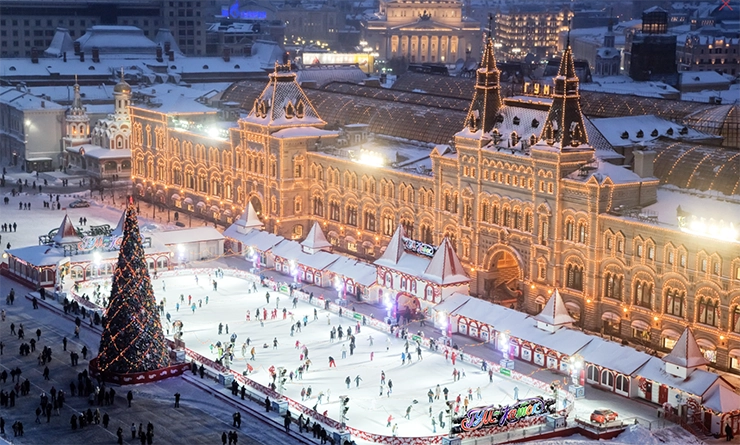
In the world of high fashion and luxury retail, the setting is just as important as the brands themselves. Architecture, atmosphere, and even shopping rituals form a distinct language of luxury. In Russia, this triad is embodied by three iconic department stores — GUM and TSUM in Moscow, and DLT in Saint Petersburg. Each of them is not just a retail space, but a cultural code of its city, reflecting its history, rhythm, and understanding of status.
GUM: Imperial elegance under a glass sky
GUM is less about shopping and more about emotions. Built at the end of the 19th century as the Upper Trading Rows, it became a symbol of Moscow’s monumentality and, at the same time, accessible luxury. Its famous glass roof, designed by engineer Vladimir Shukhov, transforms the space into a bright arcade where even a casual visit feels like a walk through a museum.
Today, GUM is a synthesis of Soviet heritage and modern commerce. It brings together boutiques of well-known brands, gastronomic projects, and iconic Soviet elements such as ice cream in a waffle cone. However, compared to TSUM and DLT, GUM is less oriented toward ultra-luxury: it is more democratic, more touristic, more “public”.
Service in GUM is neat but unobtrusive. Personal shoppers exist, but they are not a central part of the experience. This is a place for aesthetics rather than private consumption.
TSUM: Moscow maximalism and the status code
TSUM tells a different story. Located in the very center of Moscow, it has historically been connected to Western retail culture: the early 20th-century building originally belonged to Scottish entrepreneurs. Today, TSUM is the flagship of ultra-luxury in Russia, structured according to a vertical hierarchy: the higher the floor, the higher the level of brands and privacy.
Unlike GUM, TSUM is about selection and concentration. It features key fashion houses — from “Chanel” and “Dior“ to “Balenciaga” and “Saint Laurent”. The assortment is updated faster than anywhere else in the country, and buying decisions are aligned with global trends.
Service is one of the main reasons Muscovites choose TSUM. Personal shoppers, private fitting rooms, pre-selection of items, and private viewings turn shopping into a carefully orchestrated experience. TSUM is not just a store, but a tool of social positioning.
DLT: Saint Petersburg restraint and intellectual luxury
DLT in Saint Petersburg is a response to TSUM, but with a distinct northern character. The early 20th-century building, originally constructed as the House of Leningrad Trade, combines Art Nouveau and neoclassicism. After a major reconstruction, it became the city’s main luxury department store.
If TSUM is about display, DLT is about attention to detail and subtle emphasis. It features the same key brands, including Prada, Gucci, and Bottega Veneta, but their presentation is different: less aggression, more curatorial approach.
The Saint Petersburg audience values privacy and intellectual depth, and DLT takes this into account. The space feels more intimate, the service less performative but no less efficient. Personal shoppers act more like stylists than salespeople, and fitting rooms resemble private salons rather than retail booths.
Moscow and Saint Petersburg: the psychology of shopping
Why do Muscovites go to TSUM while Saint Petersburg residents prefer DLT? The answer lies not only in geography but also in cultural psychology.
Moscow is a city of speed, ambition, and visible success. Here, it is important not only to buy, but also to show. TSUM perfectly reflects this logic: it is loud, dynamic, trend-driven, and status-oriented.
Saint Petersburg is a city of reflection and internal style. Here, luxury does not shout — it whispers. DLT offers exactly this format: thoughtful, aesthetically refined, almost intimate.
GUM remains separate in this system. It does not directly compete with TSUM or DLT, instead acting as a cultural space — a point where history, tourism, and light, accessible luxury intersect.
Three models of luxury
GUM, TSUM, and DLT represent three different interpretations of luxury:
GUM — architectural heritage and emotional experience
TSUM — brand concentration and status display
DLT — intellectual luxury and privacy
The choice between them is not only a matter of taste but also a reflection of lifestyle. Ultimately, luxury today is not only what you buy, but also how and where you do it.
The post The Architecture of Russian Luxury: GUM, TSUM, and DLT Explained appeared first on The Fashiongton Post.