
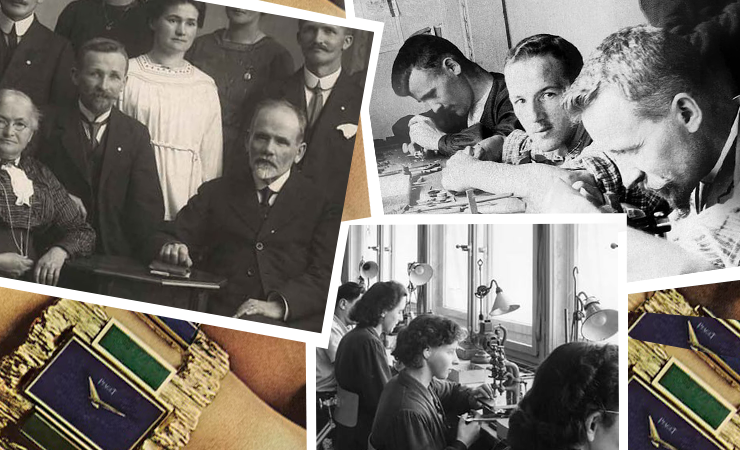
Georges Piaget (7 May 1915 – 10 November 1997) was a Swiss watchmaker whose pioneering vision transformed a family-run workshop into a global emblem of refined taste and boundary-pushing design. Born in the secluded village of La Côte-aux-Fées in the Swiss Jura Mountains, Georges inherited not only the mechanical aptitude of his watchmaking lineage but also an instinctive eye for style. The Piaget family had been involved in crafting watch movements since the 19th century, and the quiet precision of the trade was woven into Georges’ upbringing.
After completing his studies in engineering and horology, Georges returned to the family business in the 1930s, joining a modest but highly skilled enterprise that supplied movements to some of Switzerland’s most respected brands. Yet even in those early years, he sensed the potential for something greater—something more visually expressive, artistically daring, and intimately tied to the world of contemporary luxury. In 1943, the Piaget brand was formally registered, marking a clear shift from behind-the-scenes craftsmanship to the creation of complete timepieces bearing the family name.
Georges was not content to simply uphold tradition. With remarkable clarity of vision, he began reimagining the watch not just as an instrument of timekeeping but as a statement of artistry and personal identity. During the 1950s and 1960s, he oversaw the development of ultra-thin mechanical movements—an engineering feat that not only impressed connoisseurs but enabled an entirely new aesthetic direction. Slim profiles allowed for sleeker, more elegant cases, which in turn became platforms for luxurious materials, bold shapes, and unprecedented combinations of form and function.
By bringing together master watchmakers with artists, goldsmiths, and jewelers, Georges cultivated a house style that refused to recognize the usual boundaries between utility and adornment. Piaget timepieces became objects of pure visual allure—bracelet watches crafted from solid gold, dials made of lapis lazuli and malachite, and pieces so richly ornamented they echoed the sophistication of haute couture. His philosophy was that a watch should never hide beneath a cuff but instead complement a dress, elevate a gesture, or anchor a look.
Georges Piaget’s influence extended well beyond the technical or decorative. He had a profound understanding of how luxury operated as experience—discreet, immersive, and always intentional. He expanded the brand’s presence into the world’s most prestigious retail environments, from Geneva to Paris and eventually New York, yet maintained an air of exclusivity that drew a discerning clientele. His watches became coveted by film stars, socialites, and fashion icons not through aggressive promotion, but because they carried the allure of artistry fused with rarity.
Under his leadership, the Piaget name came to represent not only impeccable craftsmanship but also a spirit of creative risk—introducing watches that doubled as jewelry sculptures and redefining what a timepiece could be in the context of fashion. The boldness of the 1970s, a decade often marked by excess, found a sophisticated expression in Piaget’s designs, which embraced daring proportions without ever losing their sense of elegance. Celebrities such as Elizabeth Taylor and Andy Warhol were among the many admirers who turned Piaget watches into personal style signatures.
Even after stepping away from day-to-day operations, Georges remained intimately connected with the brand’s direction. His belief in collaboration, innovation, and craftsmanship as an art form continued to guide Piaget long after his retirement. When he passed away in 1997, he left behind more than a storied brand—he left a blueprint for how technical mastery and visual daring could coexist within a single object. Georges Piaget redefined not only what luxury looked like but how it was lived.
The post Georges Piaget appeared first on The Fashiongton Post.